Build a Technical SEO Audit Agent with PageSpeed, DNS, SSL, and WHOIS APIs
Build a technical SEO audit agent that combines readable page content, PageSpeed diagnostics, DNS, SSL, and WHOIS signals into actionable reports.
Build a Technical SEO Audit Agent with PageSpeed, DNS, SSL, and WHOIS APIs
A useful technical SEO audit needs more than a title tag checklist. Search visibility can be affected by unreadable page content, slow rendering, broken DNS, certificate problems, or domain changes. Those signals live at different scopes and should not be collapsed into one opaque score.
This guide uses GuGuData’s current readability, PageSpeed, DNS, SSL, and WHOIS endpoints to build an audit agent that separates URL-level findings from domain-level findings, compares them with a previous run, and produces prioritized work instead of a raw data dump.
Use the current GuGuData OpenAPI document as the contract source for request parameters and response schemas.
Technical SEO audit architecture
The original workflow introduces the combined page and domain audit pattern.

The process below makes the reporting boundary explicit: independent signals are normalized, compared with prior evidence, and only then converted into findings.
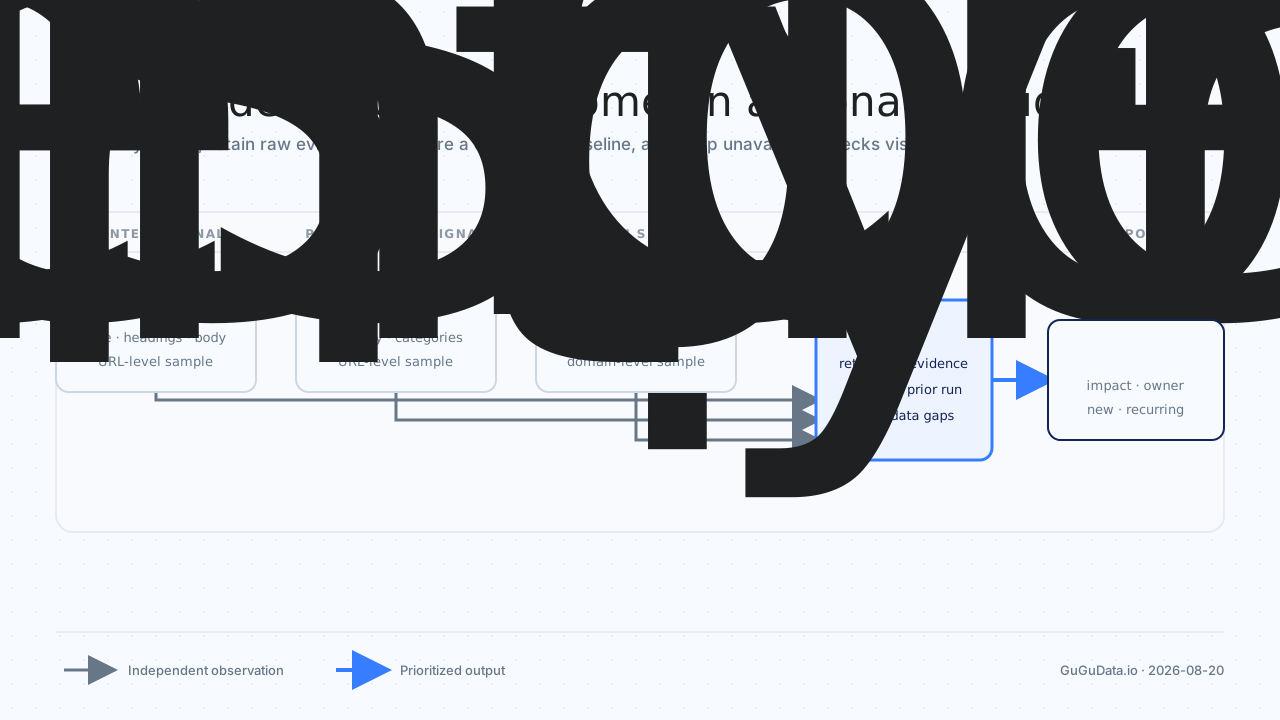
Separate URL checks from domain checks
Run page-level APIs for each important URL, but deduplicate domain-level checks across pages on the same host.
| Scope | Method and endpoint | Required input | Purpose |
|---|---|---|---|
| URL | POST /v1/websitetools/readability |
url or html in JSON |
Extract the main readable content. |
| URL | GET /v1/websitetools/pagespeed-score |
url query parameter |
Collect technical SEO and performance diagnostics. |
| Domain | GET /v1/websitetools/dns-lookup |
domain query parameter |
Inspect DNS resolution data. |
| Domain | GET /v1/websitetools/sslcertinfo |
domain query parameter |
Inspect certificate identity and validity data. |
| Domain | GET /v1/websitetools/whois |
domain query parameter |
Inspect current domain registration information. |
Every request also requires an appkey query parameter. Keep it on the server and never embed it in a browser bundle, article, or log message.
Check whether the page has readable content
The Webpage Readable Content Extraction API accepts either a target url or raw html in an application/json body.
curl -X POST \
  "https://api.gugudata.io/v1/websitetools/readability?appkey=YOUR_APPKEY" \
  -H "Content-Type: application/json" \
  -d '{"url":"https://example.com/product"}'
Do not treat extraction failure as proof that the page has no content. Record whether the page was unreachable, blocked, empty, or simply not extractable. Useful derived checks include presence of a title, main-content length, heading order, repeated boilerplate, and whether the expected language is present.
Collect PageSpeed and technical SEO diagnostics
The Technical SEO Diagnostics API is a GET endpoint with a required url. Optional query parameters currently include strategy, locale, categories, and forceRefresh.
curl -G "https://api.gugudata.io/v1/websitetools/pagespeed-score" \
  --data-urlencode "appkey=YOUR_APPKEY" \
  --data-urlencode "url=https://example.com/product" \
  --data-urlencode "strategy=mobile"
Store the raw observation time and strategy with each result. A mobile run and a desktop run are different measurements, and cached or fresh runs should not be compared without retaining that context.
Use score changes as investigation signals, not as automatic incident declarations. A single external test can move because of network or upstream conditions. Escalate when a material drop repeats or when it coincides with a release, crawl issue, or user-facing failure.
Inspect DNS, SSL, and WHOIS once per domain
The three domain endpoints share the same request shape: GET, appkey, and a required domain.
curl -G "https://api.gugudata.io/v1/websitetools/dns-lookup" \
  --data-urlencode "appkey=YOUR_APPKEY" \
  --data-urlencode "domain=example.com"

curl -G "https://api.gugudata.io/v1/websitetools/sslcertinfo" \
  --data-urlencode "appkey=YOUR_APPKEY" \
  --data-urlencode "domain=example.com"

curl -G "https://api.gugudata.io/v1/websitetools/whois" \
  --data-urlencode "appkey=YOUR_APPKEY" \
  --data-urlencode "domain=example.com"
Review the current detail pages for DNS lookup, SSL certificate audit, and WHOIS monitoring.
These checks answer different questions:
- DNS data helps identify missing, unexpected, or changed resolution records.
- SSL data supports certificate identity and validity review.
- WHOIS data provides registration context and change evidence.
A failed DNS or SSL request is an infrastructure finding, not a content-quality finding. Keep the classifications separate so the report reaches the correct owner.
Normalize findings without losing evidence
Convert API results into a common envelope while retaining the original payload reference.
from dataclasses import dataclass
from datetime import datetime


@dataclass(frozen=True)
class AuditFinding:
    check: str
    scope: str
    target: str
    severity: str
    summary: str
    observed_at: datetime
    evidence_id: str
The normalized object should not replace raw evidence. It should point to it. This lets a report stay concise while preserving enough detail for engineers to reproduce the finding.
Recommended states are healthy, observe, action_required, and unavailable. Use unavailable when the signal could not be sampled; never turn a missing observation into a passing result.
Prioritize by impact, confidence, and persistence
A deterministic rules layer is easier to audit than a language model making severity decisions from scratch.
| Dimension | Example question |
|---|---|
| Impact | Does the issue affect one low-priority URL or the whole domain? |
| Confidence | Is the evidence direct, repeated, and internally consistent? |
| Persistence | Did the same issue appear in consecutive runs? |
| Ownership | Does content, frontend, platform, or domain operations own the fix? |
| Urgency | Is the page unavailable or is this an optimization opportunity? |
The agent can summarize evidence and draft next steps after these rules assign a category. Keep the underlying values and previous-run comparison visible in the report.
Suggested report structure
| Section | Content |
|---|---|
| Executive summary | Material changes and highest-priority work. |
| URL findings | Readability and PageSpeed observations per page. |
| Domain findings | DNS, SSL, and WHOIS observations per host. |
| Changes since last run | New, resolved, recurring, and unavailable checks. |
| Action queue | Owner, priority, evidence link, and next verification time. |
For large sites, sample templates rather than every URL on every run. Include the home page, major landing-page templates, high-traffic content, and recently changed pages. Run domain checks once per distinct domain and reuse them across the report.
Reliability and rate control
- Set bounded concurrency separately for URL and domain checks.
- Cache stable domain observations for an appropriate interval.
- Retry transient
500and503responses with bounded backoff. - Treat
429as a platform limit and pause rather than increasing concurrency. - Preserve failed and unavailable states in trend data.
- Compare like-for-like PageSpeed strategy and category settings.
- Alert on repeated or high-impact changes, not every isolated fluctuation.
FAQ
Is a PageSpeed score enough for a technical SEO audit?
No. It is one page-level signal. Readable content, crawlable output, DNS, certificate state, and domain context can fail independently and need separate evidence.
Should I run DNS, SSL, and WHOIS for every URL?
No. Deduplicate by domain. A site may have thousands of URLs but only a small number of hosts that need domain-level checks.
Can the agent mark a check healthy when an API call fails?
No. Use an explicit unavailable state. A missing sample is a data gap, not evidence of health.
How should I avoid noisy alerts?
Use impact thresholds, consecutive failures, and comparison with a consistent baseline. Keep isolated external-test variation in observation until it repeats or aligns with user-facing evidence.
Related GuGuData guides
- Webpage readable content extraction
- PageSpeed and SEO score API guide
- DNS lookup API guide
- SSL certificate API guide
- WHOIS lookup API guide
Explore the current API catalog at GuGuData.io.